Field Geological Report

Rock & Mineral Specimen Analysis

Visual identification and geological characterisation of field specimens

Tanzania — Small-Scale Mining Context

Specimens
4
Date
May 10, 2026
Gold Potential
Very High (Spec. 3)
Geological Setting
Archaean Greenstone Belt
1

Gossanous Iron Oxide / Ferruginous Laterite
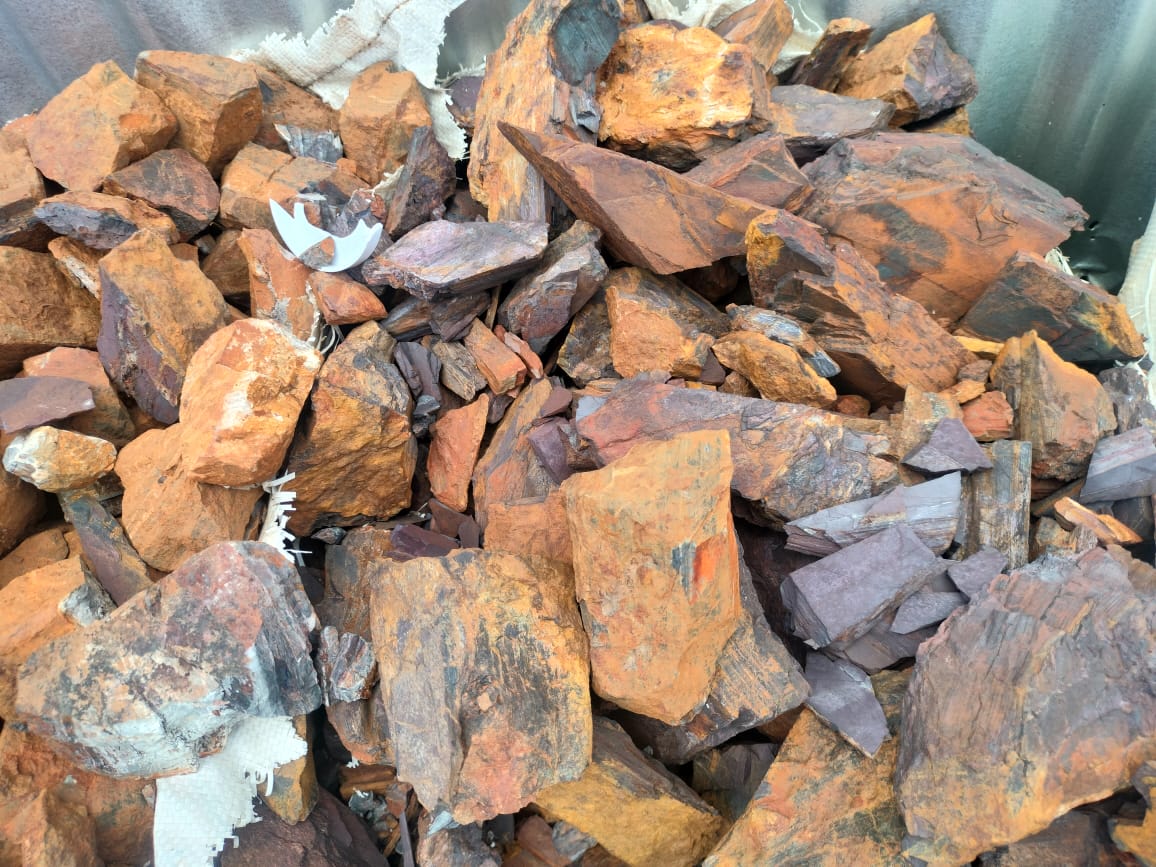
Bulk stockpile — angular rock fragments
Gossanous iron oxide rock pile
Specimen 1 — Rock Stockpile
★★ Priority 2
Gossanous Iron Oxide / Ferruginous Laterite
Secondary (Supergene) — oxidation of primary sulphide or BIF protolith
Medium Confidence Secondary / Supergene Gold Indicator
Lithology
Gossanous iron oxide rock; ferruginous laterite cap overlying probable sulphide or BIF source
Mineral Composition
Dominant limonite (FeO·OH) and goethite; hematite in darker cores; residual quartz (white patches); possible remnant pyrite
Texture
Massive to earthy; cryptocrystalline iron oxide matrix; relict angular fracture surfaces suggesting original schistose protolith
Grain Size
Very fine to cryptocrystalline (<0.1 mm); original grain size obscured by alteration
Color
Rust-red to bright orange (limonite/goethite); dark reddish-brown patches (hematite cores); white flecks (residual quartz)
Structure
Massive; angular platy fracture pattern suggests inherited foliation from metamorphic protolith
Shearing
Slight — angular fracture geometry and planar surfaces suggest brittle deformation prior to oxidation
Weathering
HIGH — complete iron oxide replacement of original mineralogy; classic lateritic oxidation profile
Veining
Not clearly resolvable at stockpile scale; individual clasts may contain vein remnants
Formation
Lateritic gossan cap; Archaean or Proterozoic greenstone belt or metasedimentary setting, NW Tanzania
⚡ Mineralization
Gossan-type iron oxide assemblage. Gossans of this character commonly overlie gold, copper, or zinc sulphide mineralisation. This is a prospecting indicator — the primary ore target lies below. Locate the in-situ source and check for sulphide remnants (pyrite boxwork) beneath the gossan.
Economic Value
Moderate — indirect indicator. The gossan itself has limited direct value, but its presence marks the oxidised top of a potentially economic sulphide body below. Tanzania-equivalent settings include Geita (gold), Shinyanga (diamonds, gold), Mwanza region.
Field Recommendation
Sample the darkest, most massive pieces for geochemical assay. Locate the in-situ source outcrop and profile downward — look for sulphide remnants (visible pyrite) beneath the orange cap. Map the gossan extent laterally to estimate the footprint of the body below.
2

Banded Iron Formation (BIF) / Ferruginous Metasediment
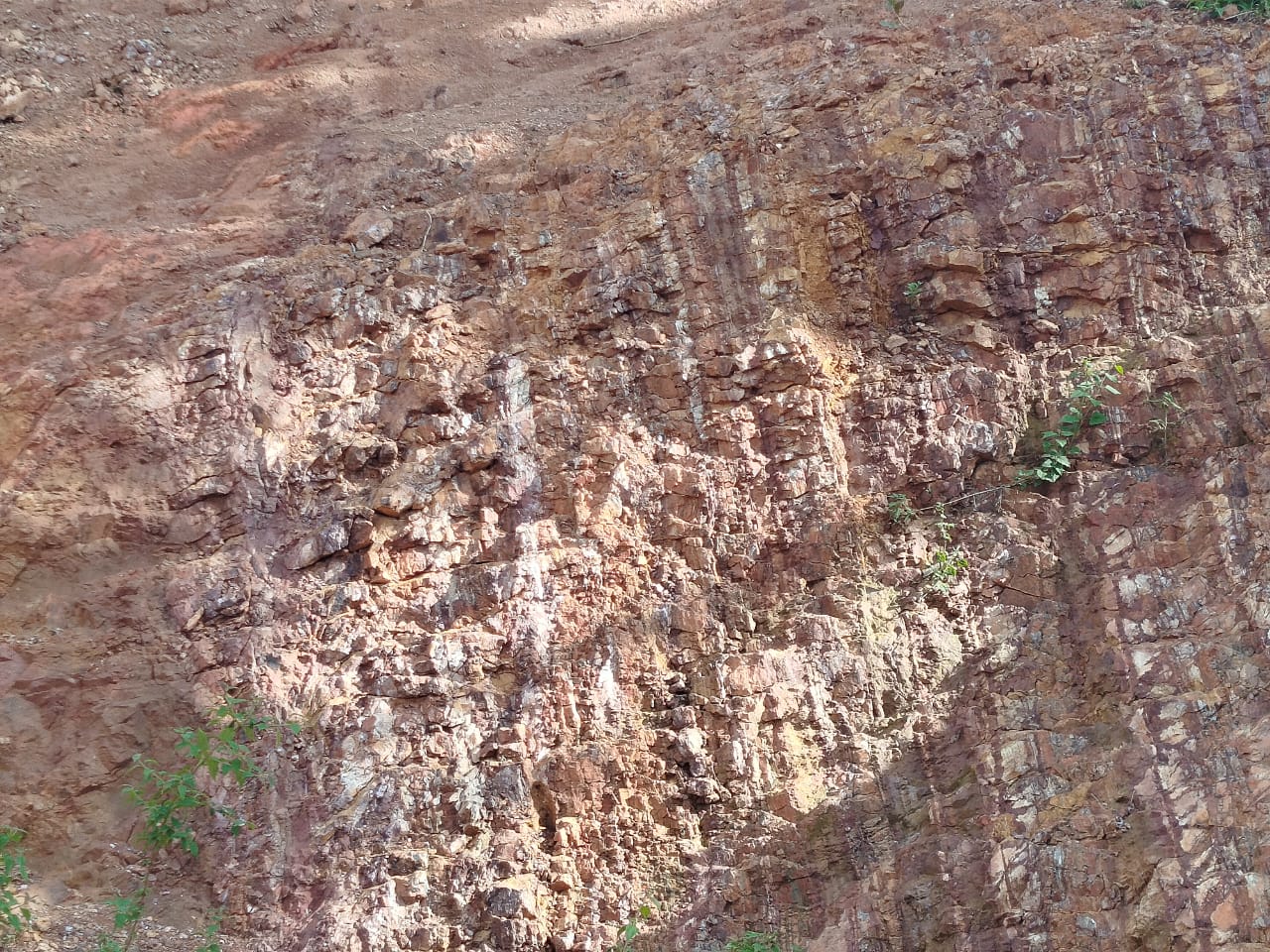
In-situ rock face / quarry wall exposure
BIF rock outcrop cliff face
Specimen 2 — Rock Face / Outcrop
★★★ Priority 3
Banded Iron Formation (BIF) / Ferruginous Metasediment
Metamorphic — Archaean metasedimentary sequence, greenstone belt setting
Medium Confidence Metamorphic Hydrothermal Gold Potential
Lithology
Deeply weathered ferruginous metasedimentary rock — most likely Banded Iron Formation (BIF) or iron-rich schist; consistent with Archaean greenstone belt geology of NW Tanzania
Mineral Composition
Iron oxides (hematite, limonite, goethite) in red-brown bands; quartz or chert in pale/cream bands; possible chlorite or muscovite (greenish tints in shaded zones)
Texture
Fine-grained to aphanitic; schistose to finely banded; bands typically <5 mm thick; white siliceous zones are coarser (saccharoidal quartz)
Grain Size
Very fine (<0.25 mm) in iron-rich bands; fine to medium in silica bands
Color
Reddish-brown to deep red (iron oxide bands); cream to pale white (silica/quartz bands); pale orange in intensely leached zones
Structure
Clear horizontal to gently dipping banding/layering (primary BIF fabric); sub-vertical fractures cutting across banding (tectonic joints); white silica masses may be structurally controlled quartz pods
Shearing
Moderate — sub-vertical streaks and fracture zones mid-section suggest brittle–ductile shear zones cross-cutting primary layering; structurally important for targeting hydrothermal gold
Weathering
VERY HIGH (surface) / Moderate (depth) — full lateritic weathering profile at surface; reddish-orange limonite throughout; lower sections show less advanced weathering
Veining
Present — white silica/quartz vein zones in lower-centre; sub-horizontal to moderately dipping orientation; these should be sampled and assayed for gold
Formation
BIF-hosted sequence; Archaean greenstone belt (2.5–3.0 Ga); NW Tanzania — same geological setting as Geita Gold Mine
⚡ Mineralization
BIF-hosted iron (non-commercial at surface due to weathering). Critical observation: white silica pods/zones visible in the lower-centre of the face represent potential hydrothermal alteration zones. In Tanzania BIF settings these are strongly associated with orogenic gold mineralisation (Geita Gold Mine style — Tanzania's largest gold producer operates in this exact geology).
Economic Value
Moderate–High potential. BIF iron grades at surface are typically sub-economic due to dilution, but the hydrothermal silica zones have gold potential. Known Tanzania locations: Geita (Geita Gold Mine), Mwanza, Shinyanga.
Field Recommendation
Map the orientation (strike/dip) of both the primary BIF banding and the cross-cutting shear zones. Sample white silica zones specifically for gold assay. Compare with regional geological maps for proximity to known greenstone belt shear corridors. Consider a systematic chip sampling programme across the face.
3

Mafic Rock with Quartz Vein — Gold Indicator
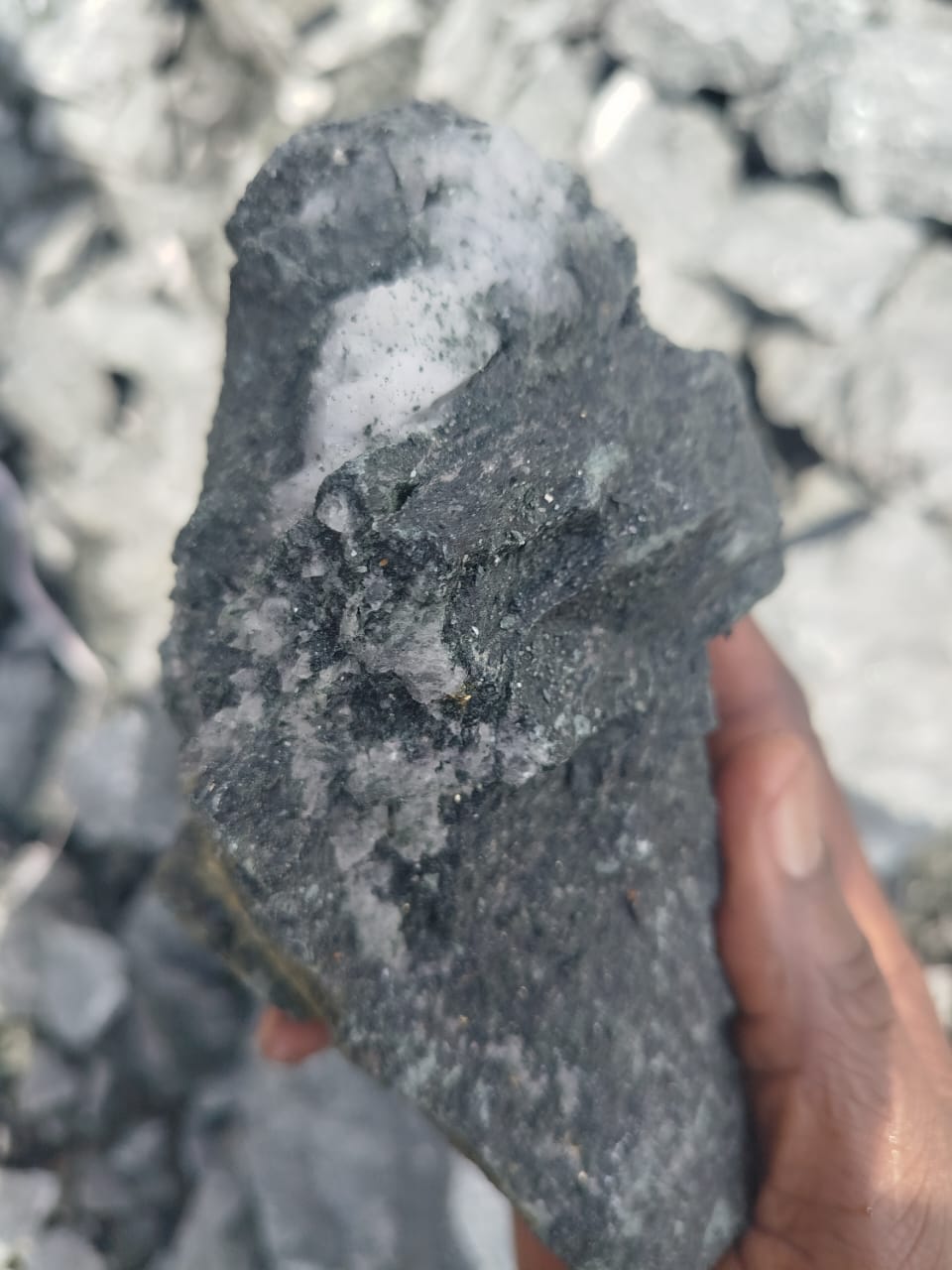
Hand specimen — highest economic priority
Mafic rock with quartz veining and metallic specks
Specimen 3 — Hand Sample (PRIORITY)
★ PRIORITY 1
Quartz-Veined Mafic/Ultramafic Rock
Igneous protolith (metamorphosed) — cut by hydrothermal quartz veining along shear zone
High Confidence Igneous / Metamorphic 🔶 Visible Metallic Specks
⚠ IMPORTANT NOTE
Tiny gold-yellow metallic specks are visible within the white quartz zone of this specimen. This is consistent with native gold or associated sulphide minerals (pyrite, chalcopyrite) and requires immediate laboratory verification by fire assay.
Lithology
Dark mafic/ultramafic rock (gabbro, dolerite, amphibolite, or serpentinite) hosting prominent quartz ± carbonate veining — classic orogenic gold-bearing rock type
Mineral Composition
Matrix: pyroxene or amphibole (dark greenish-black), possibly serpentine or chlorite. Vein material: white quartz dominant ± calcite. Vein zone: gold-yellow metallic specks consistent with native gold or pyrite/chalcopyrite. Vein margins: chlorite alteration (pathfinder mineral for gold)
Texture
Matrix: fine to medium-grained, massive. Vein zone: coarser crystalline quartz. Vein-wall contacts show alteration halos (chloritisation) — typical of hydrothermal gold systems
Grain Size
Matrix: fine (0.1–1 mm); quartz vein: medium to coarse (1–5 mm crystals visible in image)
Color
Matrix: dark grey to greenish-black (primary mineralogy, not weathering). Vein: white to light grey. Alteration halo: pale greenish-grey. Specks: gold-yellow metallic lustre
Structure
Massive mafic host; vein orientation appears sub-vertical to steeply dipping (based on specimen geometry); vein thickness estimated 2–4 cm
Shearing
Significant — vein margins show ductile deformation textures indicating the vein was emplaced along a shear zone; structural setting is the primary control on orogenic gold deposits
Weathering
LOW — specimen appears relatively fresh with only minor surface oxidation; dark colour is primary mineralogy
Veining
Prominent quartz ± carbonate vein, ~2–4 cm wide; irregular vein margins and internal crystal growth; extensional or shear-hosted style; chlorite alteration selvage at contacts
Formation
Mafic intrusion or volcanic sequence in Archaean greenstone belt; hydrothermal quartz veining along structural shear zone — identical geological setting to Tanzania's largest gold mines
⚡ Mineralization — VERY HIGH POTENTIAL
Quartz veining in mafic host rock with visible metallic specks and chlorite alteration is the textbook signature for orogenic gold mineralisation. Chlorite at vein margins is a well-documented pathfinder mineral for gold in greenstone belt settings. The gold-yellow specks in the quartz zone are highly significant and require immediate assay. If gold grade is economic, the source shear zone must be mapped and systematically sampled.
Economic Value — HIGHEST PRIORITY
Very high potential. Orogenic gold deposits hosted in mafic rocks with quartz veining account for the majority of Tanzania's gold production (Geita, Bulyanhulu, North Mara, Shinyanga). Known Tanzania locations: Geita region, Mwanza, Tabora, Shinyanga.
Field Recommendation — URGENT
1. Crush a 200–500 g sample and pan for free gold immediately. 2. Send a 1 kg split for fire assay (gold) — this is the definitive test. 3. Map the vein system in the field: identify orientation (strike/dip), continuity, and whether it forms part of a larger vein corridor or stockwork. 4. Use a UV lamp at night to check for fluorescence. 5. If gold is confirmed, engage a licensed geologist for systematic sampling and resource assessment.
4

Silicified Quartzite with Iron Oxide Boxwork
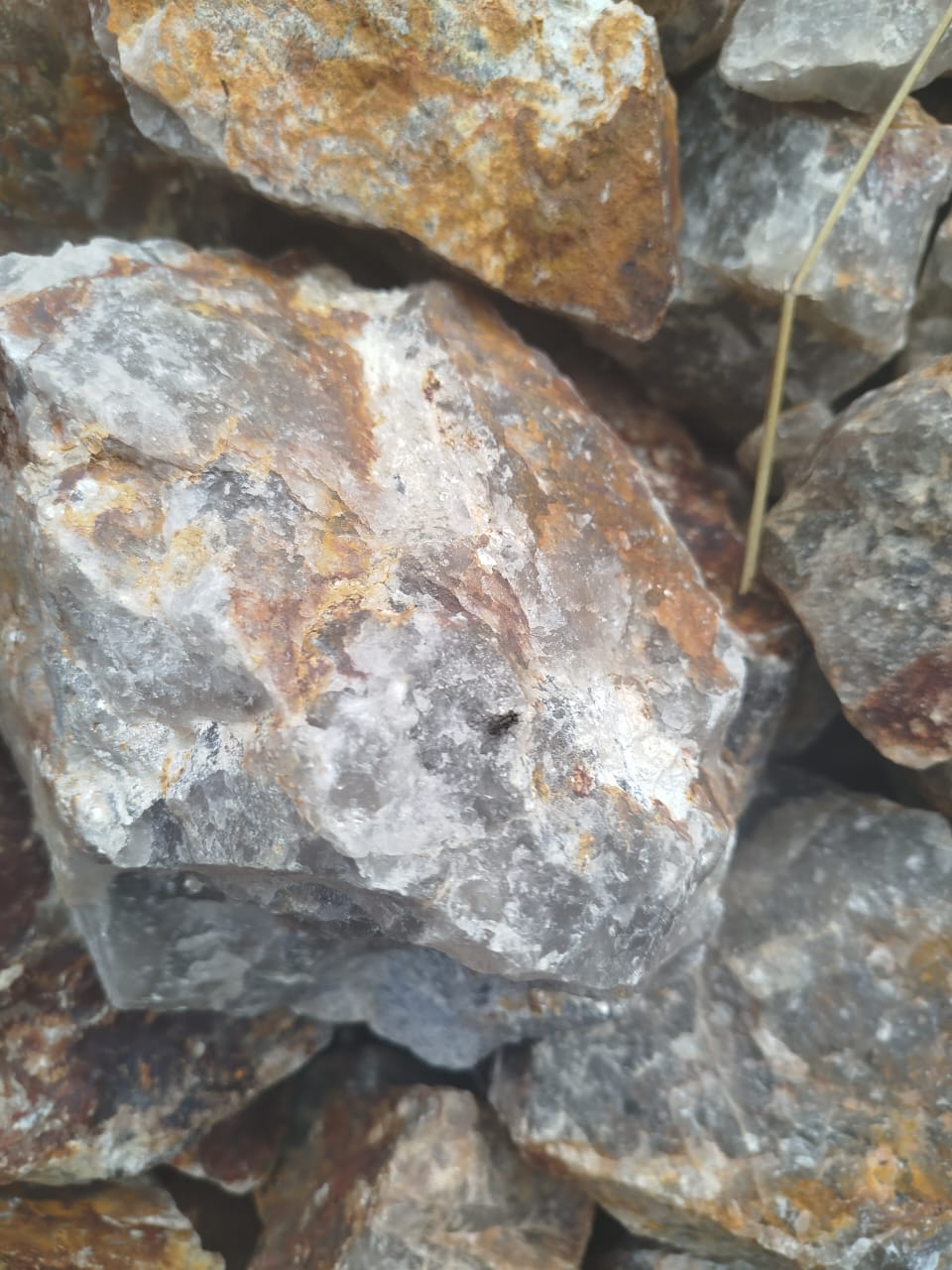
Close-up of multiple quartz-dominant rocks with leached sulphide fractures
Quartz rock with iron oxide boxwork staining
Specimen 4 — Quartz + Boxwork
★★ Priority 2
Silicified Quartzite / Quartz Vein Rock with Iron Oxide Boxwork
Metamorphic or hydrothermal — silicified shear zone or quartzite with leached sulphide fractures
High Confidence Metamorphic / Hydrothermal Leached Sulphide Indicator
Lithology
Silicified rock / ferruginous quartzite or quartz-dominant vein rock with boxwork iron oxide along fractures; consistent with a hydrothermal silicification zone
Mineral Composition
Dominant quartz (white to pale grey, translucent); limonite/goethite along fractures (orange boxwork); possible feldspar (pale grey areas); dark inclusions suggest remnant sulphide minerals (now oxidised)
Texture
Massive to granular; saccharoidal quartz in fresh white zones; iron oxide boxwork infill along fractures is fine-grained
Grain Size
Fine to medium quartz grains (0.25–2 mm); sub-crystalline in fresher areas
Color
White to pale grey (primary quartz); pale lilac/lavender tint in main specimen (possible fluorite or iron-stained quartz); bright orange-rust along fractures (limonite/goethite boxwork)
Structure
Massive; fracture network with iron oxide infill creating a boxwork pattern; possible relict banding in some pieces; brittle fracture system
Shearing
Moderate — fracture system indicates brittle deformation consistent with a silicified shear corridor; fracture orientation may indicate stress field direction
Weathering
MODERATE — selective weathering: quartz is resistant (fresh faces preserved), fractures are heavily weathered (orange iron oxide infill); boxwork pattern itself is a weathering product of original pyrite
Veining
Rock itself may be massive vein material (quartz vein rock); secondary fracture veins infilled with iron oxide (oxidised pyrite); primary quartz ± sulphide veining is the likely precursor
Formation
Silicified zone in metamorphic or volcanic sequence; hydrothermal alteration along structural corridor; Archaean–Proterozoic age probable; NW Tanzania greenstone belt or mobile belt
⚡ Mineralization — High Potential
The orange boxwork pattern is the residual iron oxide left after pyrite (FeS₂) was dissolved by weathering fluids. In gold mining: pyrite commonly co-precipitates with gold, so boxwork in silicified rock = leached sulphide zone = strong gold exploration indicator. The pale lilac colouration may indicate fluorite, sometimes associated with gold-bearing hydrothermal systems. Map the spatial distribution of the boxwork to define the silicified corridor.
Economic Value
High potential as an indicator. Silicified zones with boxwork are prime targets for gold sampling in Tanzania. Known locations for this geology: Shinyanga, Mwanza, Geita, Singida regions.
Field Recommendation
Sample systematically across the fracture zone. Use a UV lamp at night — fluorite and some gold-associated minerals fluoresce distinctively. Send 1–2 kg for fire assay (gold). Map the spatial relationship between this silicified zone and the BIF outcrop in Specimen 2 — they may belong to the same hydrothermal system.

Summary — Priority Assessment

Priority Specimen Rock Type Key Indicator Recommended Action
1 — Urgent Specimen 3
Hand sample
Mafic rock + quartz vein Visible metallic specks in quartz; chlorite alteration halos; shear-hosted vein Crush & pan for free gold; fire assay 1 kg split; map the vein system
2 — High Specimen 4
Rock pile
Silicified quartzite + boxwork Orange iron oxide boxwork = leached pyrite = former sulphide zone Fire assay; UV lamp survey; map silicified corridor extent
2 — High Specimen 1
Stockpile
Gossanous iron oxide Gossan cap = surficial indicator of sulphide body below Assay for Au, Cu, Zn; locate in-situ source; profile depth
3 — Moderate Specimen 2
Outcrop
Banded Iron Formation BIF host + hydrothermal silica pods + shear zones Chip sample silica zones; map shear structures; compare with regional geology

Overall Geological Setting

These four specimens together are consistent with an Archaean greenstone belt setting in NW Tanzania (Mwanza / Geita / Shinyanga region), where banded iron formations have been cut by hydrothermal gold-bearing quartz veins along structural shear zones. This is precisely the geological setting of Tanzania's largest gold mines — Geita Gold Mine (AngloGold Ashanti), Bulyanhulu, North Mara, and Tulawaka.

The progression from gossan cap (Specimen 1) → BIF host rock with hydrothermal alteration (Specimen 2) → fresh quartz-veined mafic specimen with metallic specks (Specimen 3) → silicified boxwork zone (Specimen 4) represents a coherent exploration target. The specimens are spatially and geologically related, not isolated occurrences. A systematic chip-sampling and geochemical programme across the area is strongly recommended before any further investment or extraction activity.